AI-native service companies (AINS): interesting for VC or not?
For twenty years, the venture capital industry has invested following a simple rule: software scales efficiently while services do not. A SaaS company can grow revenue tenfold without hiring tenfold; a consulting firm cannot. This rule shaped which companies got funded, how they were valued, and what startup founders were expected to build.
Nowadays, a new type of company is questioning that rule: AI-native service (AINS) companies that could scale just as efficiently as software, as outlined in a recent article by Sequoia.
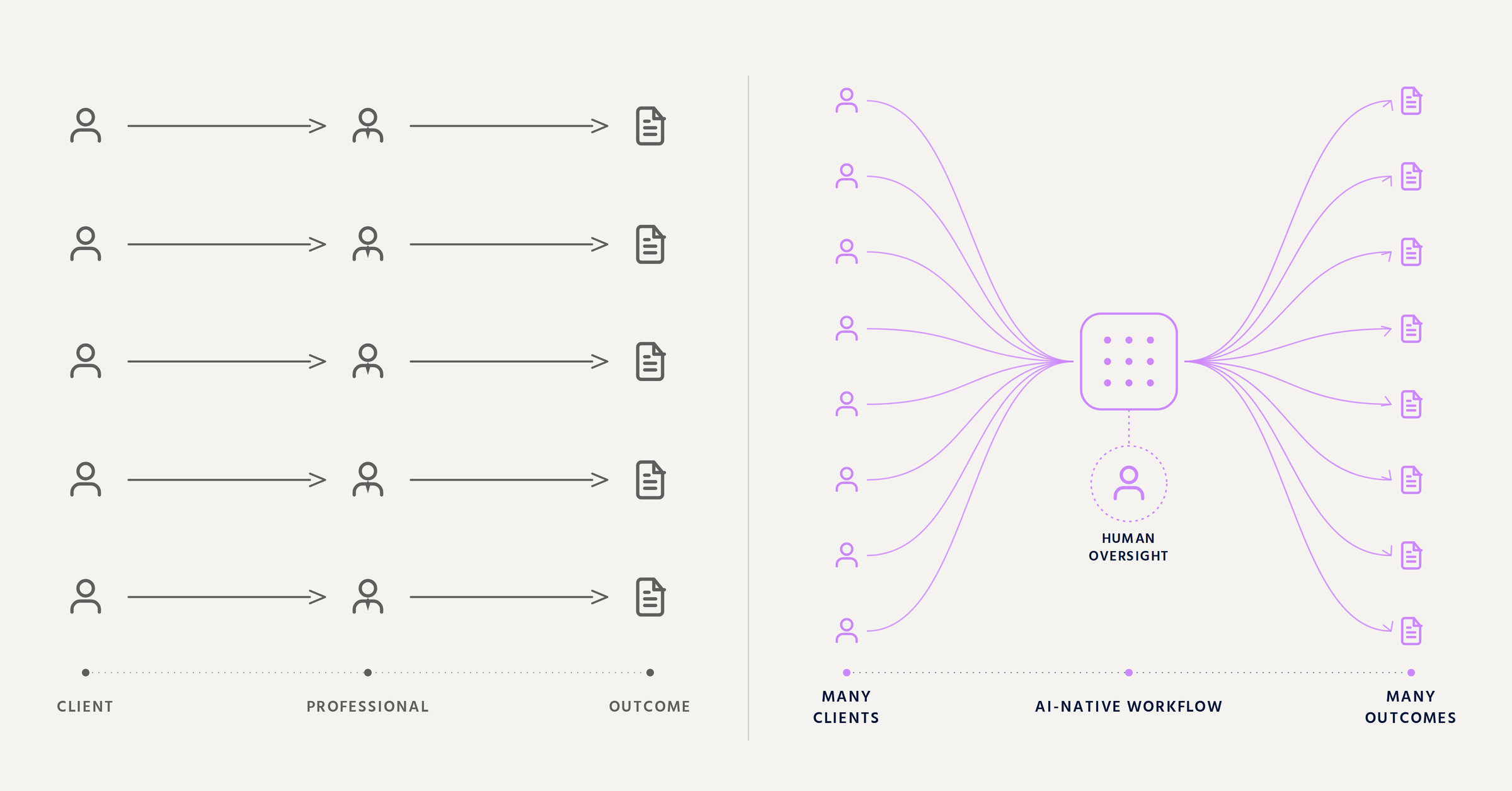
AINS companies sell outcomes directly to end customers, with services delivered primarily by AI agents and humans acting as supervisors or fallback. These AINS companies combine the trust of professional services with the scalability of software. They are not just selling tools, but actually carrying out the work.
The difference that matters
This distinction between selling tools and selling outcomes cuts through a lot of the confusion on whether a company qualifies as AINS or not. Let’s look at two firms in the legal sector as an example.
Legora, often cited as an “AI legal company,” is in fact a vertical SaaS platform. Law firms use Legora’s AI tools to draft documents and run research more efficiently, but the lawyer remains responsible for delivering outputs and outcomes to the end customer.
The same judgement applies to companies like Clio or Filevine. Their products improve workflows and results, but the service provider does not change.
On the other hand, an AI-native law firm looks different. For example, London-based Garfield AI operates as an SRA-regulated law firm focused on debt recovery. AI handles the claims process and legal paperwork, while regulated solicitors oversee quality and retain accountability. The client is buying legal advice from Garfield, not software.
The distinction is not semantic. It impacts revenue model, margins, go-to-market, and defensibility.
However, not every AI-enabled services business qualifies as an AINS company. We see three defining characteristics:
- They sell the outcome, not the tool. The client is paying for an end result, not access to a platform or tool that can produce the result. Typical claims are: "We handle your bookkeeping", "we manage your customer support", or "we run your invoice collection." This influences the go-to-market, the pricing, and the accountability structure.
- AI executes the core work while humans retain accountability. The system runs workflows end-to-end, while people handle edge cases and regulatory responsibility. The human layer does not need to grow linearly with revenue.
- The model compounds over time. Every case handled, every invoice reconciled, every contract reviewed is a training signal making the AI more accurate. This virtuous cycle is defensible: competitors cannot replicate it by spending more, only by operating longer or on more cases.
The businesses that meet the above three points are not a hybrid of software and services. They are something new and require a different investment framework to be evaluated.
Why AINS are appearing now
The size of the market for AINS companies is vast. The total addressable market for AI-native services is not informed by software budget, but by labour budget. In its seminal article, Sequoia estimated that, for every dollar spent on software tools, six are spent on services. Accounting and audit alone represent tens of billions annually in outsourced spend. Legal transactional work, insurance brokerage, recruitment, and compliance add hundreds of billions more. These are large, labour-intensive markets now being reshaped from within.
The driver is not just technological progress, but structural constraint. While demand continues to grow, the US has lost roughly 340,000 accountants in recent years and around 75% of US-based CPAs are nearing retirement. In the legal sector, the billable-hour model has created a permanent access gap: most businesses cannot afford the rates of a large firm for routine transactional work. In compliance and HR, regulatory complexity grows faster than headcount can absorb it.
AI-native service companies are entering these markets because the incumbents, with their delivery model based on human professionals billing by the hour, are structurally strained and can’t meet the rising demand.
Evaluating the category: why the standard framework doesn't fit
The first instinct of investors valuing this new category of AI-enabled service companies is to apply the same method and discount as for the traditional service companies, which have low gross margins, little defensibility, and no venture-like scale. However, there is more nuance to it.
On margins: It’s true that the starting point is lower than in SaaS. But the relevant question is about trajectory. In an AI-native model, the human layer exists for exceptions, not throughput. A company starting at 40% gross margin and scaling toward 60% as automation improves and exceptions are less frequent is fundamentally different from a firm structurally capped at 40% with no path upward.
On defensibility: The key asset is the data flywheel. The companies that will define this category in five years are generating training data today that no competitor can easily replicate. Crucially, the flywheel only compounds if it is instrumented from day one: founders capturing structured data from every workflow and continuously fine-tuning are building a more defensible asset.
On venture-like scale: The size of the market is not in question; the constraint is distribution. Traditional services are unable to scale because they rely on bespoke sales and delivery. AI-native companies mitigate this by targeting fragmented SME bases, standardising pricing, and compressing onboarding. AINS companies may not be identical to SaaS in go-to-market, but they are closer than any services model before them. The AINS companies that solve the distribution problem will scale in ways that traditional professional services firms simply cannot.
The AI-enabled businesses that deserve a services-company discount are those that have not built the flywheel, have not structured for scale, and cannot articulate their margin trajectory. The AI-enabled services companies that have done the work, with a clear path on margins, a data asset compounding from day one, and a go-to-market built for the SME base, are worthy of venture capital investment.
The European opportunity
As usual, the US has moved faster in AI-enabled services businesses. For instance, Crosby reviews commercial contracts as an AI-native law firm, charging per document and delivering redlines within an hour. It went from a $6M seed to a $60M Series B and a $400M valuation in under 15 months. WithCoverage raised a $42M Series B led by Sequoia and Khosla to disrupt insurance brokerage with a flat-fee, outcome-driven model. The proof of concept, at speed and at scale, is clear.
Europe is not far behind, and in some ways is better positioned. Professional services are deeply local, shaped by regulation, language, and trust. Simply adapting a US product for local markets may not be enough, whereas a company designed from the outset to operate across multiple geographies has an advantage. European founders who build compliance-first, with the regulatory fluency and SME relationships that come from operating on home ground, are not playing catch-up. They are building something the US market cannot easily replicate.
A market this complex might be well suited to organic growth. In Spain, TaxDown has taken a few years to master the tax system but it now processes more personal income tax returns in Spain than any other private tool or advisory service, with AI handling the analysis and filing and 200 tax advisors supervising the output.
However, there are certain conditions that might make an inorganic growth strategy unusually accessible in the next few years. A large share of the SMEs in most countries in the OCDE are owner-operated and face generational transition (baby boomers approaching retirement) with no clear succession plan. Many of these firms trade on traditional services multiples, disconnected from what their economics could look like if the services were provided by AI. The operator who proves that it can transform an acquired asset thanks to AI will not need to argue the thesis; they will show it in the P&L after a single acquisition.
Lawhive has already demonstrated the model works on this side of the Atlantic with its acquisition of Woodstock Legal Services in 2025. This was not an acqui-hire, but a AINS company buying the client relationships and regulatory standing needed to operate at scale. The move highlights one way this category can consolidate in Europe: not by acquiring headcount, but by absorbing the institutional infrastructure of the incumbents being replaced. We are just waiting to see European players betting on this move since a single acquisition can deliver what building from scratch would take years to accumulate: regulatory standing, an existing book of clients to train models on, and the local trust that a new brand cannot buy. This is similar to the concept of Private Reverse Merger (PReM) described by Index Ventures’ Martin Mignot.
The proof points exist. What is still missing in Europe is volume: the pipeline of companies at this stage of development remains limited. However, the window of opportunity will not stay open indefinitely; the compounding advantages are accrued by whoever moves first… and gets it right.
Closing thoughts
The question "are AI-native service companies interesting for VC investment?" will keep getting asked. It is also increasingly beside the point. The businesses being built in this category are not hybrids – they are something entirely new. The investors and founders who treat them as such will have an advantage over those still reaching for the nearest familiar benchmark.
If you are building an AI-native service company in Europe, we want to hear from you.